When a drain backs up, the first question is usually practical rather than technical: who is responsible for fixing it. Getting that answer right matters, because it can save time, prevent property damage and stop you paying for work that should not be yours to arrange.
In London and Surrey, drainage problems are often made more confusing by older housing stock, Victorian terraces, converted flats, rear extensions and small outdoor spaces where pipe runs are not easy to trace. Shared drainage is common, and many homeowners are unsure where their responsibility ends and the water company’s begins.
This guide explains the difference between private drains and public sewers, how the 2011 rules changed responsibility, what shared drains mean in practice, and when it makes sense to contact the water company before booking private drainage work.
Start with the basic rule: private drains versus public sewers
In simple terms, you are usually responsible for drains that serve only your property and sit within your boundary. The water company is usually responsible for public sewers and most shared pipework outside that definition.
A drain is the pipe carrying wastewater away from your home until it joins another drain from a neighbouring property. Once pipework serves more than one property, it is generally classed as a sewer. That distinction is often the key to working out who should deal with a blockage.
- Private drain: usually serves only your property
- Public sewer: usually serves more than one property
- Shared drainage: often becomes the water company’s responsibility
- Boundary location matters, but who the pipe serves matters just as much
The 2011 transfer explained simply
In 2011, responsibility for many shared drains and lateral drains transferred from homeowners to water and sewerage companies. A lateral drain is the section of pipe that carries waste away from your property but runs beyond your boundary before joining a sewer.
That means even if part of the pipe relates to your home, you may not be responsible for it if it is shared or if it falls into the transferred categories. This is why it is worth checking before paying for drainage work, especially where pipe runs are not obvious.
- If a pipe only serves your home and remains your private drain, it is usually your responsibility
- If the pipe is shared with neighbours, it is often the water company’s responsibility
- If the pipe leaves your property boundary as a lateral drain, it may also be the water company’s responsibility
- Older deeds and assumptions are not always reliable after the 2011 transfer
Shared drains are common in London and Surrey streets
Terraced houses, semis, mansion blocks and flat conversions often have drainage layouts that are less straightforward than modern detached homes. Multiple kitchens, bathrooms and utility connections may have been added over time, and some properties share underground runs even when the owners do not realise it.
A useful clue is whether neighbours are seeing similar problems at the same time. If your downstairs WC is slow to empty and next door has gurgling sinks or an overflowing gully, that points towards a shared issue rather than a blockage affecting only your property.
Rear access can also affect what happens next. In streets with narrow side returns, basements, small paved gardens and limited manhole access, identifying the exact run may take some investigation before anyone can say with confidence who is responsible.
- Ask immediate neighbours if they have slow drains, bad smells or backing up
- Check whether external gullies, inspection chambers or shared manholes are overflowing
- Look at where the problem appears: one fitting, one branch, or several rooms at once
- Keep notes and photos if sewage is backing up or covers are surcharging
What you can safely check before calling anyone
You do not need specialist equipment to make a sensible first assessment. The aim is not to diagnose the whole system, but to work out whether the problem looks local to your home or more likely to involve shared or public pipework.
Start inside. If only one basin, shower or sink is slow, the blockage may be close to that fitting. If several fixtures are affected, especially on the ground floor, the problem may be further along the line.
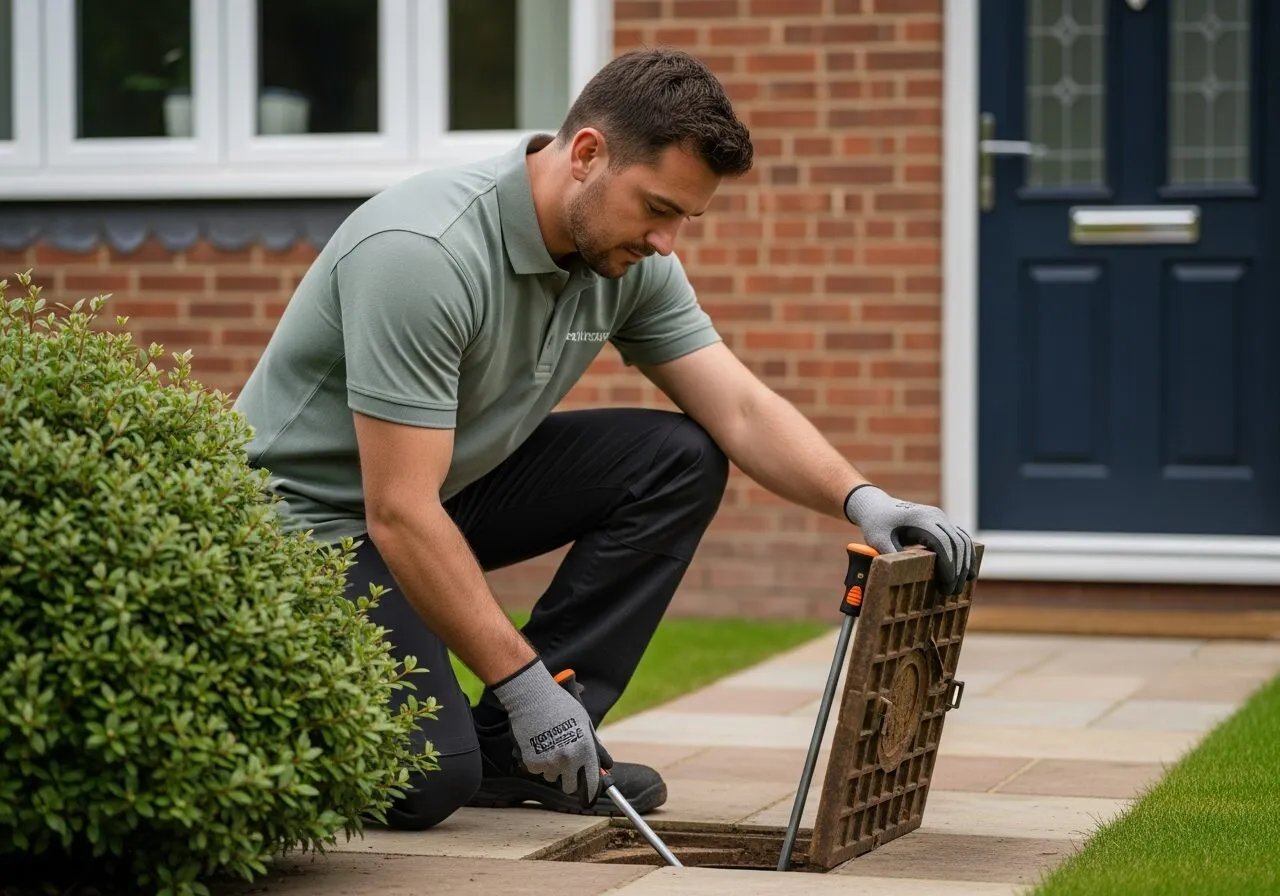
Then check outside if it is safe to do so. A gully full of standing foul water, an overflowing inspection chamber or sewage backing up at the lowest point are all signs that the blockage may be deeper in the system.
- Try a plunger on a single slow sink or WC if the blockage appears local
- Remove and clean accessible trap waste under a basin or sink if you are confident doing so
- Do not use drain rods through indoor fittings unless you know exactly what you are doing
- Be cautious with chemical drain cleaners, especially in older pipework and flat conversions
- Do not lift heavy covers alone or enter any chamber space
When to call the water company first
Call the water company first if you suspect the problem is in a shared drain, a sewer or a lateral drain beyond your boundary. This is often the right step where more than one property is affected, an outside chamber serving several homes is full, or foul water is coming back up from below rather than failing to leave one fitting.
This can save you paying for a private visit that cannot resolve a public network issue. It also helps if access is awkward, such as on-street covers, shared rear alleys or drainage runs crossing neighbouring land.
- Neighbours have the same problem at the same time
- A shared manhole or chamber is surcharging
- The blockage appears beyond your property boundary
- Wastewater is backing up at the lowest outlet in the system
- You live in a flat conversion and the issue clearly affects more than one unit
When to bring in a professional and how CS Services can help
If the issue appears to be on a private drain, keeps returning, or you cannot tell where responsibility lies, professional advice is sensible. Recurring blockages, foul smells outside, patchy wet ground, slow drainage across several fittings and any sign of sewage ingress should not be left to develop.
Local property types matter. Older clay pipework, historic alterations, hard water deposits, root ingress and limited access all affect how drainage issues show up in London and Surrey homes.
CS Services covers London and Surrey and can advise on private drainage issues and likely next steps. Drainage is currently advertised as coming soon, so enquiries are welcome ahead of launch, and it is still worth checking with the water company first where shared or public responsibility looks likely.
Key Takeaways
- You are usually responsible for drains serving only your property.
- Shared drains and many lateral drains are often the water company’s responsibility.
- The 2011 transfer changed who looks after much underground pipework.
- If neighbours are affected too, contact the water company first.
- Recurring blockages and sewage backing up need professional attention.
Frequently Asked Questions
Am I responsible for a blocked drain outside my house?
Not always. If the pipe only serves your property, you are usually responsible. If it is a shared drain or a lateral drain covered by the 2011 transfer rules, the water company may be responsible instead.
How can I tell if a drain is shared with my neighbour?
A common sign is that both properties have problems at the same time, such as slow toilets, gurgling wastes or overflowing outside chambers. In terraces and conversions, shared runs are common even when they are not obvious from the surface.
Should I try to clear a blocked drain myself?
You can safely try simple steps for a local blockage, such as plunging a single WC or clearing an accessible trap under a sink. Avoid aggressive chemicals, avoid forcing rods through internal pipework, and stop if several fittings are affected or foul water is backing up outside.
When should I call the water company before a drainage contractor?
Call the water company first if neighbours are affected, a shared chamber is overflowing, or the blockage appears beyond your property boundary. That can save time and prevent you arranging private work for a problem that is not yours to own.
Can drainage problems get worse if I leave them for a few days?
Yes. A partial blockage can become a full blockage, and backed-up wastewater can damage floors, walls and outdoor areas. Early action is especially important in older properties, basements and homes with limited external drainage access.